Think of PLR Notion templates as a professional "starter kit" for your digital product business. You're essentially buying a pre-built, fully functional Notion template with special permissions—the right to legally rebrand it, modify it, and sell it as your very own.
For creators and influencers, this is a game-changer. It lets you skip the steep learning curve and the hundreds of hours it takes to build a complex, interconnected Notion system from the ground up.
What Are PLR Notion Templates?
Let's use an analogy. Say you're a talented interior designer who wants to sell a line of custom furniture. Instead of chopping down the trees and milling the lumber yourself, you start with a high-quality, pre-assembled wooden chair. You have the right to sand it, paint it your signature color, add custom upholstery, and then sell it under your own brand.
That's exactly what PLR Notion templates offer.
PLR stands for Private Label Rights. This license is the key—it grants you the legal permission to take a product someone else created and treat it as your own. You can change the colors, fonts, and icons to match your brand, edit the content to reflect your unique expertise, and most importantly, sell it to your audience. It’s a powerful shortcut to launching a digital product.
This image really highlights the core permissions that make PLR so attractive for creators.
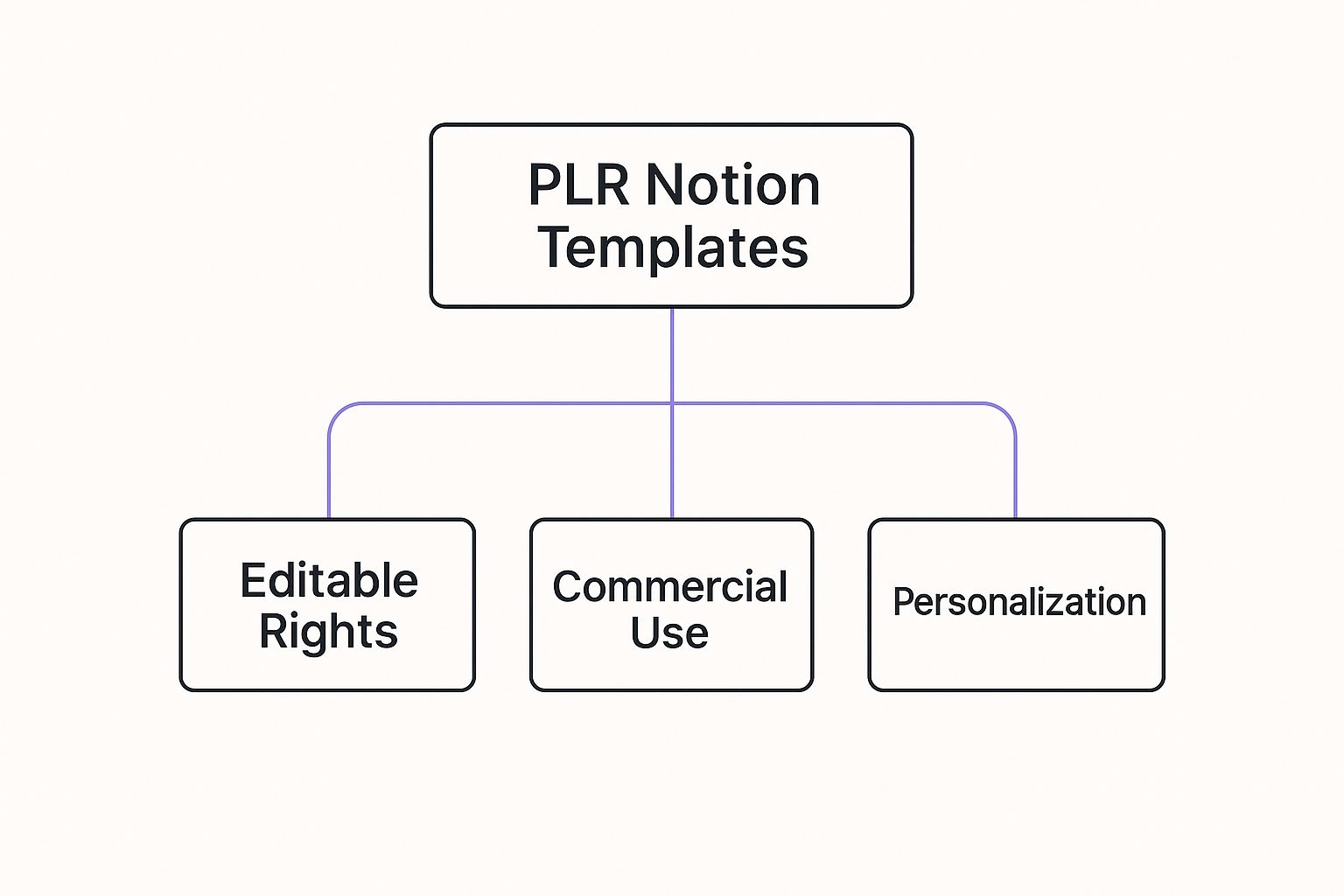
As you can see, having the ability to both edit and resell the template is what allows you to turn a generic base into a unique product that truly represents your brand.
Understanding Your Digital Product Rights
It's easy to get confused by the different types of licenses for digital products. PLR is just one of several common models, and knowing the difference is crucial to staying on the right side of the terms of use. This table breaks down what you can (and can't) do with each.
| License Type | Can You Rebrand It? | Can You Resell It? | Can You Edit Content? | Typical Use Case |
| :— | :— | :— | :— |
| Private Label Rights (PLR) | Yes | Yes | Yes | Rebranding and reselling as your own unique product. |
| Master Resell Rights (MRR) | No | Yes | No | Selling the product "as is" and also selling the rights to sell it. |
| Resell Rights (RR) | No | Yes | No | Selling the product "as is" to end-users without passing on resell rights. |
| Personal Use | No | No | Sometimes | Using the product for your own needs, like a personal planner. |
Understanding these distinctions ensures you're building your business on a solid, legal foundation. With PLR, you have the most creative freedom, which is why it’s so popular for building a brand.
The Core Advantage: Speed and Simplicity
The biggest win with PLR Notion templates is speed.
Honestly, building a polished Notion dashboard with relational databases, rollups, and complex formulas can be a massive time sink. It can easily take hundreds of hours of deep, focused work. For most creators, that's a huge barrier.
A PLR template completely eliminates that development phase. You're not starting from a blank page; you're starting from the finish line and just adding your final, personal touches.
Instead of getting bogged down in the technical weeds of Notion, you can stay in your zone of genius: creating amazing content and serving your community. This means you can get a high-quality product to market fast, start generating passive income, and test ideas without a huge upfront investment of your time.
Tapping Into a Growing Market
The demand for organizational systems is exploding, and Notion is leading the charge. With a user base that has swelled to over 35 million people worldwide, there’s a massive, built-in audience actively looking for ways to streamline their lives and work.
This growth means you're not just creating a product; you're meeting a real, existing demand. By offering well-designed templates under your brand, you can solve your audience's problems directly. If you're curious about this business model, you can explore more about this digital product trend and find tips on getting started.
Ultimately, it’s a win-win situation:
- You (The Creator): You get a premium product to sell without the development headaches, opening up a new and scalable revenue stream.
- Your Audience: They get a functional, beautiful tool that solves a genuine problem, saving them from frustration and wasted time.
By starting with a solid PLR foundation, you can deliver real value, build your authority, and turn your creative influence into a sustainable business.
Why Creators Should Sell PLR Notion Templates
Sure, saving time is a great perk, but if that’s all you see, you’re missing the bigger picture. The real magic of PLR Notion templates for creators is how they can strategically accelerate your business. Think of them less as a simple shortcut and more as a launchpad for building a stronger, more diverse brand.
This isn’t just about working smarter; it’s about growing your business in a fundamentally better way. For influencers and creators, PLR templates offer a direct line to launching a digital product without the massive, time-sucking effort of starting from scratch.
Launch Products at the Speed of Culture
The digital world moves fast. A new trend can pop up on TikTok or Instagram and create immediate demand for related tools. If you’re building a complex digital product from the ground up, it can take months—and by then, the wave has already crested.
PLR Notion templates change the game. They give you the agility to capitalize on trends while they’re still hot. Let’s say a new productivity method goes viral. Instead of spending the next six months designing a system, you can grab a high-quality PLR template from our store, customize it to fit the new method, and get it in front of your audience in days. That kind of speed is a massive competitive advantage.
Enter the Market with Minimal Risk
Every new product is a bit of a gamble. Will your audience actually buy it? Is the price point right? Sinking hundreds of hours into something that ultimately flops is a painful lesson for any creator.
This is where PLR templates really shine, as they dramatically lower the stakes. Your main investment is a small licensing fee, not weeks or months of your irreplaceable time. It creates a low-risk playground to test out new product ideas and see what your audience responds to. You get to make decisions based on real data, not just a gut feeling, without risking a major loss.
For creators, PLR isn't just about selling a product; it's about validating an idea. It's a low-cost, high-speed way to test the market, gather feedback, and discover what your audience truly wants to buy.
This cycle of testing and learning is priceless. It helps you zero in on what works for your specific community, so you can pour your energy into products that have a proven demand.
Build a True Passive Income Stream
As a creator, your income is often tied directly to your active work—brand deals, sponsored posts, and affiliate links. These are great, but they all require you to be constantly doing something. A digital product, on the other hand, can be a source of genuine passive income.
Once you’ve customized your PLR Notion template and listed it for sale, it can bring in revenue 24/7 without any more of your direct involvement. It’s the kind of income that works for you while you’re sleeping, creating your next video, or taking a much-needed vacation. This diversification is crucial for building a sustainable, long-term creator business.
Elevate Your Brand Authority
Maybe the most powerful benefit of all is how it transforms your brand. When you sell a high-value tool that helps your audience get more organized or productive, you shift from being an "influencer" to a trusted expert. You're no longer just recommending products—you're creating the solutions yourself.
This simple act builds incredible loyalty and trust. Your followers see you as someone who is genuinely invested in their success, providing tangible tools that make a real difference. It cements your authority in your niche and fosters a much deeper connection with your community. They start to see you as a leader who not only inspires but also empowers them, making your brand an essential part of their journey.
How to Spot High-Quality PLR Templates
When you're wading into the world of private label rights, you’ll quickly find that not all products are made with the same level of care. Since you're putting your brand's reputation on the line with a PLR Notion template, quality isn't just a bonus—it's everything. Selling a clunky or confusing template is a fast way to lose customer trust, so learning to spot a winner is one of the most important skills you can develop.
Think of it like being a home inspector. A great template has solid bones: a clean design, a logical structure, and an experience that just works. A bad one might look decent at a glance but quickly reveals its flaws once you start clicking around. Your job is to find the templates that genuinely help your customers and make them glad they bought from you.
Your Pre-Purchase Inspection Checklist
Before you hit "buy" on any PLR template, mentally run it through a quick inspection. A top-tier template really shines in three areas: its usability, its structure, and its design. When these three things come together, you get a product you can be truly proud to put your name on.
After all, a premium template is more than just pretty visuals; it needs to solve a real problem for the person using it. It should feel intuitive, like it's making their life easier from the get-go.
Here’s what to look for:
- Logical Flow and Navigation: Is it immediately obvious where to go and what to do? A good template will have a clear hierarchy, usually centered around a main dashboard that links out to all the important sections. Your customer should be able to get their bearings instantly.
- A Clear Purpose: The template needs to be laser-focused on solving a specific problem, whether that's managing a content calendar or tracking business finances. If you can't tell its exact purpose within a minute, your customers won't be able to either.
- Effective Database Structure: The real magic of Notion is in its databases. Peek inside and see if they're set up intelligently. Are the properties useful? Are the relations and rollups working correctly? For instance, in a project management template, tasks should be properly linked back to their parent projects.
The best PLR Notion templates feel like they were custom-built for the end user. They anticipate needs, eliminate friction, and guide the user toward their goals without requiring a manual.
Evaluating the Technical Foundation
Beyond that first impression, you need to look under the hood. A template's technical build is what determines how easy it is to customize and how well it will scale for your customers. A weak technical foundation will be a headache for you and a nightmare for them.
This is really where the pros are separated from the amateurs. A well-built template is a joy to work with. A poorly constructed one just creates more problems than it solves.
Key Technical Red Flags to Avoid:
- Overly Complex Formulas: Wildly complicated or broken formulas are a massive red flag. A great template uses simple, efficient formulas that are easy to understand and don't break the second you add a new entry.
- Lack of Scalability: The template has to be built for growth. Ask yourself: what happens if my customer adds 500 entries to this database? A well-designed system will handle that volume gracefully without becoming laggy or cluttered.
- No Clear Instructions: Reputable PLR creators almost always include a "Start Here" page or some simple instructions explaining how the template is meant to be used. If there's no guidance at all, it suggests a lack of care from the original creator.
Ultimately, choosing high-quality PLR Notion templates is an act of brand protection. When you source your products from trusted shops like PLR Digital Products, you're giving yourself a head start with a solid, well-crafted foundation. This lets you focus your energy on what you do best—adding your unique branding and value—knowing the core product is something your audience will genuinely love.
Turning a Generic Template Into a Signature Product
Getting your hands on a good PLR template is just the starting line. The real magic happens in the next step: turning that solid foundation into a product that screams you. Simply reselling a template as-is is a huge missed opportunity. The real win comes from injecting your personality, expertise, and unique understanding of what your audience actually needs.
Think of the PLR template as a pre-stretched canvas. It’s up to you to add the colors, strokes, and details that make it a piece of art only you could have created. This is how you transform a generic tool into a premium, must-have resource for your community.
Your Customization Playbook
The goal here is to make the template feel like it was born from your brand. This goes way beyond just swapping out a logo. A thoughtful approach ensures the final product feels intentional and perfectly aligned with everything you do.
Here’s a simple playbook to get you there:
- Brand Aesthetics: Start with the visuals. Change the fonts, colors, icons, and cover images to match your brand's style guide. When it looks like it belongs with your other content, it instantly builds trust.
- Rewrite in Your Voice: Every piece of text, from the instructions to the page titles, should sound like you wrote it. Ditch the placeholder copy and rewrite everything in your unique tone. Got a catchphrase you're known for? This is the place to use it.
- Add or Remove Features: Put yourself in your audience's shoes. What’s missing that would be a game-changer for them? What's included that’s just clutter? Don’t be afraid to add whole new databases or gut entire sections that don’t serve a purpose.
The core of value creation lies in modification. A generic template serves everyone okay, but a customized template serves your niche perfectly. That perfection is what people are willing to pay a premium for.
This kind of strategic editing is what turns a basic tool into an indispensable solution for your specific audience.
The Power of a Signature Feature
If you really want your template to stand out, you need to add a signature feature. This is that one special, high-value addition that nobody else has. It becomes your unique selling point—the main reason a customer chooses your product over all the others.
Let's say you bought a generic 'Content Planner' PLR template. To turn it into a premium 'YouTube Creator's Growth Hub,' you could build in a signature feature like a "Viral Video Deconstructor" database. This unique tool could have fields for breaking down top-performing videos, tracking audience retention on your hooks, and even outlining A/B tests for your thumbnails.
Examples of Signature Features:
- For a Fitness Coach: Add a "Macro-Calculated Meal Prep" database to a generic workout planner.
- For a Business Mentor: Include a "Sponsorship Outreach Tracker" complete with pre-written email scripts inside a creator business hub.
- For a Student Influencer: Build a "Spaced Repetition Study Schedule" right into a standard digital notebook.
This one, well-executed feature makes your product completely unique and easily justifies a higher price.
Validating Your Product in the Market
As you customize, it’s always smart to see what's already working out in the wild. A quick look at marketplaces like Etsy shows that PLR Notion templates are booming, proving there's a real global appetite for them. Sellers are consistently pulling in 4 and 5-star reviews, which points to high customer satisfaction when the quality and customization are on point.
You’ll also notice sellers bundling multiple templates together to offer more value and justify a higher price. It’s a great way to see how others are positioning their products, so take some time to explore the current market trends for yourself.
By following this playbook, you're doing more than just editing a file. You’re building a valuable digital asset that solves a real problem, solidifies your authority, and opens up a new income stream for your business.
Getting Your Branded Template Into Your Customers' Hands
Alright, you’ve put in the work. You took a standard PLR file and polished it into something uniquely yours—a powerful tool that reflects your brand and expertise. Now for the exciting part: getting it to the people who need it most and turning your hard work into a real income stream.
This isn't about becoming a pushy salesperson. It's about showing your audience how your template solves a real problem for them. As a creator, you’ve already built the most important asset you need: trust. Now, let’s connect your solution to their needs.
Your Digital Storefront: The Product Listing
Think of your product listing as your shop window. It’s the very first impression someone gets, and a weak one can sink even the most brilliant template. Your goal is simple: make a potential buyer feel like you created this exact solution just for them.
To nail this, you need two things:
- Words that Sell: Forget listing features. Focus on the benefits. A feature is what it is (e.g., "a task database"). A benefit is what it does for them (e.g., "finally tames your chaotic to-do list so you can focus on what actually moves the needle"). Speak directly to their frustrations and their goals.
- Stunning Mockups: We all buy with our eyes first. Use tools like Canva or Placeit to create clean, professional mockups. Show your template looking sharp on a laptop or tablet screen. It makes your digital product feel tangible and high-value. This is your chance to show off your branding and the beautiful, intuitive design you created.
Where to Sell Your Template
The "where" is just as important as the "how." You’ve got a few great options, and you don’t have to stick to just one. In fact, many successful creators use a mix of channels to get their work out there.
| Sales Channel | Best For | The Big Win |
|---|---|---|
| Your Own Website | Creators with an existing audience | You keep 100% of the profits and control every pixel of the customer experience. |
| Gumroad | Getting started quickly | It’s incredibly simple to set up. Creators love it for its no-fuss, direct-to-audience vibe. |
| Etsy | Reaching new buyers | You can tap into a massive marketplace where people are actively searching for digital templates. |
If you've got a blog that gets steady traffic, selling directly from your site is a no-brainer. If you're just starting out and want to get moving fast, Gumroad is your best friend. And if you want to put your template in front of a built-in sea of buyers, Etsy is a powerhouse.
Marketing That Feels Like You
Here’s where being a creator gives you a massive edge. You don't need a huge advertising budget. You just need to show your product to the people who already know and trust you.
The best marketing doesn't feel like marketing at all. It’s not about interrupting people; it’s about weaving your product into the valuable content you’re already making.
Here are a few proven ways to do it:
- Talk to Your Email List: Your email subscribers are your VIPs. They're your most engaged followers. Launch your template to them first, maybe with a special discount as a thank-you for their loyalty.
- Show It In Action: Don't just tell people how great it is—show them. Film a quick TikTok, Instagram Reel, or YouTube Short walking them through it. Show off the main dashboard and highlight that one killer feature you designed. Let them see for themselves how it solves a problem.
- Run a Launch Promotion: Make an event out of it! Offer a special introductory price for the first week. This creates a bit of urgency and helps drive those crucial first sales, which builds momentum and social proof for the long run.
The demand for these kinds of products is exploding. The digital product resale market, which includes PLR Notion templates, is seeing 20-30% annual growth. This is largely driven by people who want powerful tools without the headache of setting them up from scratch—a major pain point for about 70% of users trying a new tool. By using these strategies, you’re perfectly positioned to meet that demand. You can explore more data on reselling digital products on entrepedia.co and see just how big this opportunity really is.
Frequently Asked Questions About PLR Templates
Thinking about jumping into the world of PLR Notion templates? It's a smart move, but we get that you probably have a few questions before you dive in. It's only natural. This section is all about giving you straight, simple answers to the most common questions we hear from creators just like you.
Our goal here is to give you that last bit of confidence and clarity you need to get started. Think of this as your final pre-flight check before building an exciting new income stream.
Is It Legal to Resell PLR Notion Templates?
Yes, absolutely. It's 100% legal. The whole business model is built on something called a Private Label Rights (PLR) license. When you buy a product with this license, you're not just buying the template; you're buying the right to change it, put your own brand on it, and sell it as your own.
But here’s the crucial part: you have to read the license terms from whoever you buy from. It's a simple step that saves a lot of headaches. Reputable sellers like PLR Digital Products will always have clear, easy-to-understand rules.
A very common rule is that you can sell your finished, customized template to your customers, but you can't sell them the resell rights. This is a good thing—it means your customer gets an amazing tool for their own use, but they can't turn around and sell it themselves. It protects the value for you and the original creator.
It’s just like buying commercial-use fonts or graphics. You can use them in your paid products, but you can't just bundle up the original font files and sell them to other designers. Same idea here.
How Much Can I Realistically Earn Selling These?
This is the big question, isn't it? The truth is, your income potential comes down to three things: your audience, your marketing, and the effort you put into making the template uniquely yours. There’s no magic number—it can be anything from a nice little side income to a full-blown business.
Some creators pull in a few hundred dollars a month, which is a fantastic way to supplement their income. But on the other end, we’ve seen top sellers build six-figure businesses by treating their digital product stores seriously.
Think about it this way: a super-specific, high-value template—like a "Small Business Tax Prep Hub" or a "Podcast Launch Kit"—can easily sell for $49 to $99, or even more. If you have an engaged email list and a solid launch plan, a single product can bring in thousands in just the first week.
It all comes down to your mindset. If you see this as a get-rich-quick scheme, you’ll be disappointed. But if you see it as building a real product line that genuinely helps your audience, the sky's the limit.
Do I Need to Be a Notion Expert?
Nope, not at all. You don't need to be some kind of Notion wizard to make this work. All you really need is a basic grasp of how Notion works—the kind of stuff you can learn from a few YouTube videos or just by clicking around in the app for an hour.
The whole point of buying a quality PLR Notion template is that the heavy lifting is already done for you. The original creator has already tackled the hard parts:
- Complex Formulas: Those brain-melting
if()statements? Already built. - Database Relations: The smart connections that link projects to tasks? Already set up.
- Advanced Rollups: Those powerful summaries that pull in data from other pages? All configured.
Your job isn't to be a tech developer; it's to be the creative director. You get to focus on the fun stuff you're probably already good at, like changing cover images, picking brand colors, and tweaking the text so it sounds like you.
Here’s a great pro-tip: when you buy a template, duplicate it and use it yourself for a few days. It's the fastest way to get comfortable and see how everything works before you start customizing it for your audience.
What Are the Biggest Mistakes to Avoid?
Getting started is pretty easy, but there are a few common tripwires we see people fall into. If you can sidestep these from the get-go, you'll be on a much faster track to building a brand that people trust.
The #1 mistake, without a doubt, is reselling a template exactly as you bought it. Don't do it. It instantly makes your product feel generic and cheap. It adds zero value, forces you to compete on price, and honestly, it just looks lazy to your customers.
The second huge pitfall is having a weak (or non-existent) marketing plan. Just putting your template up on a store and hoping people find it is not a strategy. You have to be proactive.
You need to create beautiful, enticing mockups that make your template look like the premium product it is. Then, get out there and promote it! Show it off in an Instagram Reel, write a story-driven email to your list, and talk about the specific problem it solves.
Finally, a mistake that’s surprisingly common is dropping the ball on customer support. Even with a perfect template, someone might have a simple question. A quick, friendly, and helpful reply can be the difference between a nasty 1-star review and a glowing 5-star recommendation. Great support builds massive trust and turns one-time buyers into loyal fans.