
So, what exactly are PLR Canva templates? Think of them as a massive head start for your digital product business. They are professionally designed, editable files created in Canva that you can legally rebrand, modify, and sell as your very own.
It's like getting a high-quality, pre-built product that's about 80% of the way done. You just step in to add your own branding, content, and unique flair before offering it to your audience. This is a game-changer for creators, influencers, and coaches who want to launch digital products fast, especially if graphic design isn't their strong suit.
The Power of a Design Shortcut
Imagine you want to sell a gorgeous digital planner but the thought of starting from a blank screen is overwhelming. Instead of spending weeks wrestling with design software or shelling out for a professional designer, you could grab a set of PLR Canva templates. This gives you a solid foundation to build on, letting you focus on the final 20% that makes the product uniquely yours.
The magic is in the license: PLR, which stands for Private Label Rights. This specific type of license is what grants you the permission to edit, rebrand, and sell something that someone else originally created. For coaches, influencers, and online business owners, it's an incredible way to add new revenue streams without a huge upfront investment of time or money.
Since bursting onto the scene in the early 2020s, PLR templates have become a go-to for savvy entrepreneurs. They offer a simple, cost-effective way to get high-quality designs with just a few clicks, slashing production time from weeks to hours. You can find some fantastic insights from PLR experts on how to best use them in your business.
At its core, PLR isn't about selling a generic, cookie-cutter product. It's about taking a professionally crafted foundation and infusing it with your unique brand, voice, and value for your specific audience. It’s a starting point, not the final destination.
This is a fantastic way to visualize where PLR templates can make the biggest impact.
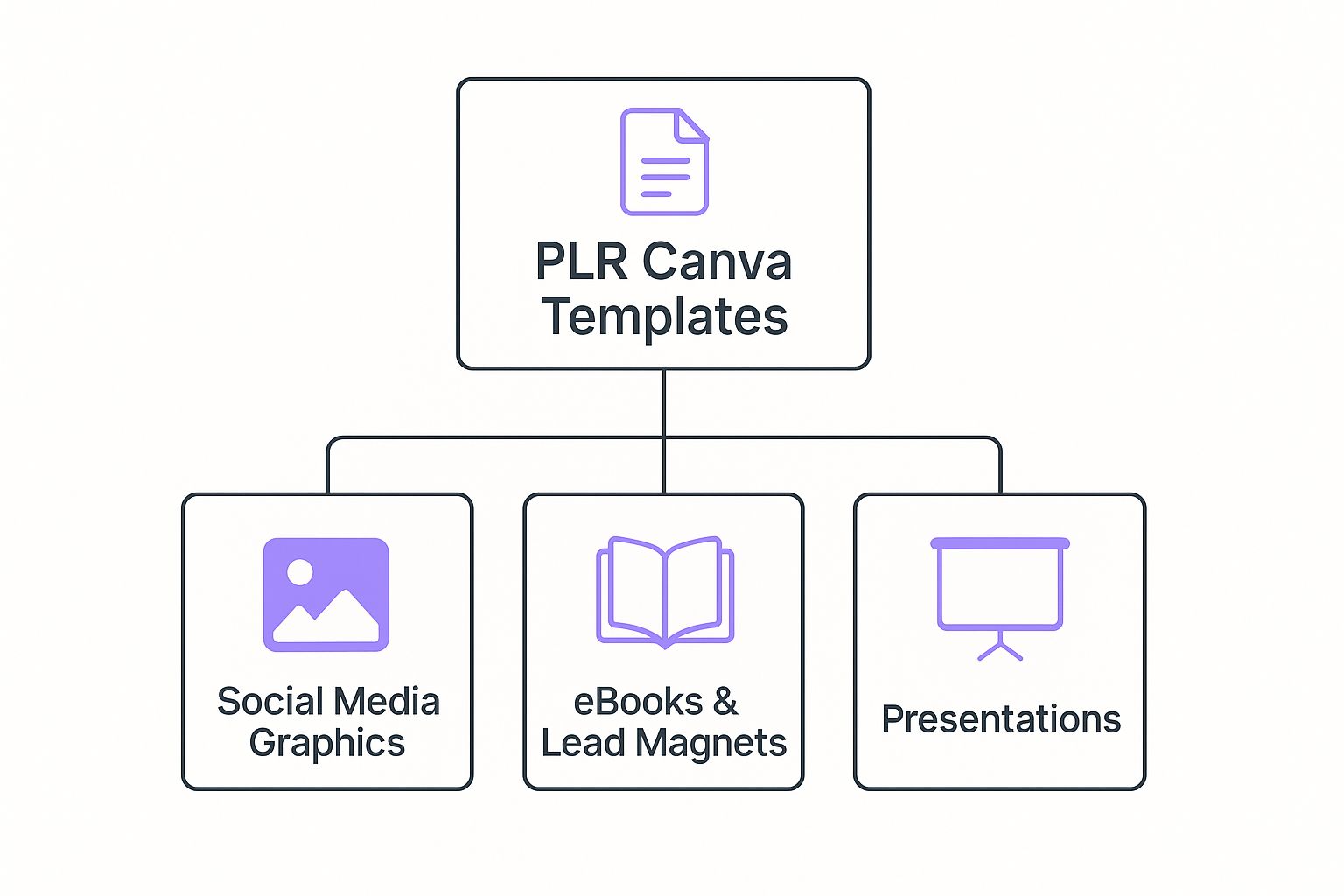
As you can see, a single PLR purchase can fuel multiple parts of your business, from your social media marketing to your lead magnets and even your core products.
PLR vs Other Digital Product Licenses
To really get why PLR is so powerful, it helps to see how it stacks up against other common licenses you'll run into. The terms can be confusing, but this table breaks it down simply.
| License Type | Can You Edit? | Can You Rebrand? | Can You Resell? | Best For |
|---|---|---|---|---|
| Private Label Rights (PLR) | Yes | Yes | Yes | Creating and selling your own unique, branded products. |
| Master Resell Rights (MRR) | No | No | Yes | Reselling a product "as is" without making changes. |
| Resell Rights (RR) | No | No | Yes | Reselling a product "as is," often with restrictions. |
| Personal Use | No | No | No | Learning from or using the content for yourself only. |
Understanding these distinctions is crucial. While other licenses have their place, PLR is the only one that gives you the creative freedom to truly make a product your own before selling it.
Key Benefits for Influencers & Creators
If you're a busy creator, influencer, or coach, you know that time is your most precious resource. PLR Canva templates are a game-changer because they directly solve your biggest headaches: a lack of time, tight budgets, and the relentless pressure to create fresh content. Instead of staring at a blank screen for weeks trying to design a new digital product, you can have a polished, professional offering ready to launch in a single afternoon.
This quick turnaround means you can finally shift your focus to the things that actually grow your business: marketing, connecting with your audience, and making sales. Imagine having an entire line of digital products ready to go, letting you serve your community consistently without the creative burnout that so often comes with starting from scratch.
Accelerate Your Product Launch
The most obvious win with PLR Canva templates is the sheer speed. You get to skip the entire initial design process, which is often a huge roadblock, especially if you aren't a designer by trade. This kind of efficiency lets you be far more nimble and responsive to what your audience wants.
- Launch in Hours, Not Weeks: Take an idea and turn it into a market-ready product in a tiny fraction of the usual time.
- Focus on High-Impact Tasks: Stop wrestling with design software and spend your valuable energy on promotion and building real relationships.
- Test Ideas Quickly: You can roll out a minimum viable product (MVP) to see if an idea has legs before you sink a ton of time and money into it.
This agility is a huge advantage. It means you can jump on a trending topic or answer a sudden flood of audience requests almost instantly, cementing your status as a go-to resource in your niche.
The real benefit isn't just saving time; it's what you do with that saved time. Every hour you're not spending on design is an hour you can pour back into revenue-generating activities.
The financial upside is just as compelling. You can buy a single PLR template bundle for a small one-time cost and then resell it over and over again, building a truly scalable passive income stream. Many sellers on platforms like Etsy report earning significant monthly income by customizing and selling PLR Canva templates, especially when they find a popular niche.
Scale Your Income Streams
PLR Canva templates aren't just for creating one-off products. They're the building blocks for an entire digital product empire. With a little creativity, a single purchase can be remixed and repurposed into several unique products for different parts of your audience.
For example, you could take one comprehensive planner template from our store and transform it into:
- A monthly goal-setting workbook for your high-ticket coaching clients.
- A weekly content calendar designed specifically for your community of fellow creators.
- Daily to-do list printables you offer as a freebie to grow your email list.
This strategy helps you squeeze every drop of value from a single asset. You create multiple income streams and give people various ways to connect with your brand. While Canva is a fantastic place to start, this repurposing mindset works across different platforms, too. For creators whose audience prefers a more organized, database-style tool, our PLR Notion templates offer another powerful way to diversify your product lineup. By catering to different tastes, you ultimately expand your reach and grow your business.
How to Legally Use PLR Designs
Diving into PLR Canva templates can feel like finding a secret shortcut to creating amazing products. But before you start selling, you need to get familiar with the rules of the road. Think of a PLR license as the permission slip that lets you use, change, and sell a design someone else created. Not all licenses are created equal, though, so knowing the details is the key to running a business that's both successful and ethical.
At its heart, Private Label Rights (PLR) offers the most creative freedom. You’re essentially buying a starting point—a design foundation that you can build upon. The single most important rule to remember is that you must significantly modify the template before you can sell it. Just taking the original file and listing it in your shop is a huge no-no. It almost always violates the terms of service and could lead to your store getting shut down.
Your Rights and Responsibilities
Getting a handle on your license isn’t just about staying out of trouble; it's about protecting the brand you're working so hard to build. Every PLR creator sets their own terms, which means you absolutely have to read the license agreement for every single product you purchase. Treat that document as your guide to operating with total confidence.
Here are a few of the most common rules you'll run into:
- Modification is Mandatory: This is the big one. You need to swap out fonts, adjust colors, move elements around, and add your own branding. The whole point is to create a new, derivative product that feels like yours.
- You Cannot Resell the Original Template: Your license gives you permission to sell the final, finished product, usually as a flattened PDF. It does not allow you to sell or give away the editable Canva template link. That would be a direct violation of the license.
- No Trademark Claims: You can't claim copyright or trademark on the original design itself. The rights you have only apply to the unique version you create after making your changes.
The golden rule of PLR is transformation. You're not just a reseller; you're a re-creator. Your job is to add value and tailor the product for your specific audience, turning a generic base into a specialized solution.
Beyond Standard PLR
While PLR is what you'll see most often, you might also come across Master Resell Rights (MRR). MRR lets you sell the product to customers who can then also sell it. The catch? MRR products usually can't be edited, which seriously limits your ability to inject your own brand's personality and style.
For any creator looking to build a distinctive product line—like our customizable PLR digital planners—sticking with a standard PLR license gives you the creative wiggle room you need. By following these guidelines, you can make sure every product you put out there is a genuine reflection of your brand's quality and vision.
Making PLR Templates Uniquely Yours
The real magic of PLR Canva templates isn't in buying them; it's in what you do next. This is where you roll up your sleeves and transform a great starting point into a one-of-a-kind bestseller that feels like it came straight from your brand. Honestly, skipping this step is what separates the creators who make a few bucks from those who build a serious digital product business.
Think of your PLR template as a professionally built, but empty, house. Just painting the front door a new color isn't enough to make it your home. You need to furnish it with your style, arrange the rooms to fit your life, and hang your art on the walls. That's what we're doing here: filling that template with your unique insights, content, and brand identity to create something your audience can only get from you.
Infuse Your Unique Value
The absolute most important thing you can do is add value that only you can provide. This is how you shift from selling a pretty design to offering a real solution. You're not just selling a generic template pack; you're selling a shortcut to success, infused with your expertise.
Let's look at a real-world example. You could buy a standard PLR social media pack and flip it, or you could do this:
- Before: A simple collection of 30 generic Instagram post templates.
- After: A branded "Instagram Jumpstart Kit for Wellness Coaches," now loaded with your unique journal prompts, motivational quotes, and specific content ideas that a wellness coach actually needs.
See the difference? You’ve injected your knowledge directly into the design, turning a commodity into an indispensable tool for a very specific person.
Your PLR Customization Checklist
To make sure your final product is truly distinct and ready to sell, it helps to follow a checklist. This isn't about making random changes; it's about layering your brand and expertise onto the original foundation until it's completely transformed.
Here’s a practical workflow to guide you through making any PLR template your own.
| Your PLR Customization Checklist | ||
|---|---|---|
| Customization Step | Why It Matters | Pro Tip |
| Brand Identity | Swapping in your brand’s colors, fonts, and logo builds instant recognition and trust. | Use Canva's "Brand Kit" feature. It lets you apply your core visuals across every page with a single click, saving you tons of time. |
| Content & Copy | This is the heart of your product. Your expert voice, prompts, or checklists are what people are really buying. | Rewrite every single heading and piece of text to match your brand's tone. A fitness coach sounds very different from a financial advisor. |
| Layout & Structure | Rearranging elements, adding or removing pages, and changing the flow creates a fresh user experience. | Found a layout you love? Duplicate that page and tweak it slightly to create bonus materials or expand your product offering. |
| Imagery & Graphics | Switching out generic stock photos for curated images or custom graphics makes the visuals feel intentional and niche-specific. | Use your own photos if you have them, or stick to a consistent style of stock imagery to create a polished, professional look. |
Following a methodical process like this ensures you're creating what's legally known as a "derivative work"—something substantially different from the original template you bought.
The goal isn't just to change the template; it's to elevate it. Your unique knowledge and brand identity are the ingredients that turn a generic recipe into a signature dish that your customers will crave.
And the market for these kinds of products? It's huge and getting bigger. As of early 2025, Canva reported having more than 220 million active users—a massive leap from 130 million in 2024. Those users have created an astounding 30 billion designs. This explosion shows a clear and growing hunger for accessible design solutions. If you can capture even a tiny sliver of those users looking for specialized, ready-to-use templates, you can build a very successful business.
Selling Your Rebranded Digital Products
Alright, you’ve put in the work and transformed a generic template into a signature product that truly shines. What's next? Getting it into the hands of your customers. A brilliant product is fantastic, but a smart sales strategy is what actually turns your effort into income. It’s about building a complete sales experience, not just listing an item for sale.
The first step, and honestly the most important, is figuring out exactly who you're selling to. Don't try to be everything to everyone. Instead, find your niche audience. Are you designing for overwhelmed real estate agents? Or maybe for aspiring wellness coaches? Perhaps you're creating for other content creators like yourself. When you know your ideal customer inside and out, you can tailor every single marketing message to their specific struggles and goals.
Creating Irresistible Product Listings
Now that you have your target customer in mind, your job is to make your product stop them in their tracks. This is where stunning visuals and persuasive descriptions become your best friends. We all buy with our eyes first, so showing off your rebranded templates professionally isn't just a suggestion—it's essential.
- Show-Stopping Mockups: Use a tool like Canva to create gorgeous mockups that show your product in a real-world context. Display your new planner on a tablet sitting next to a cup of coffee, or arrange your social media templates in a clean, stylish grid. This helps people instantly visualize how they will use and benefit from it.
- Descriptions that Convert: Write your product descriptions with a focus on the transformation you offer, not just the features. Instead of listing "30-page planner," frame it as, "A 30-page planner designed to help you conquer your weekly goals and finally reclaim your time." You're not selling pages; you're selling a solution.
Your product listing should bridge the gap between what your product is and what it does for your customer. A great mockup grabs their attention, but a great description convinces them it’s the answer they've been searching for.
Choosing Your Sales Platform
Where you decide to sell your digital products matters just as much as how you present them. Different platforms serve different audiences and sellers, and picking the right one can dramatically affect your success.
| Platform | Pros | Cons |
|---|---|---|
| Etsy | Huge built-in audience actively looking for digital goods. It’s very easy to get started. | Can have fierce competition and the marketplace takes a cut. You have less control over your brand's look and feel. |
| Shopify | Gives you total control over branding, customer experience, and pricing. No transaction fees beyond payment processing. | You have to generate all your own traffic. There's a monthly subscription fee. |
| Stan Store | A simple, all-in-one "link in bio" shop perfect for creators. Excellent for selling right from your social media profiles. | Not as customizable as a full website. Works best if you only have a handful of products. |
Each option has its perks. Etsy is a fantastic starting point for beginners who want to tap into a ready-made market. Shopify is the gold standard for building a scalable, independent brand for the long haul. And a Stan Store is a powerhouse for creators who drive most of their business through social media.
By choosing the right home for your products and creating listings that truly connect with people, you'll be well on your way to building a recognizable brand that brings in reliable sales. And for those ready to add more variety to their shop, you can explore our full collection of digital products with resell rights to expand your offerings.
Common Mistakes to Avoid With PLR
Jumping into PLR Canva templates is a fantastic way to start building a passive income stream, but it's easy to get tripped up right at the beginning. We've seen countless enthusiastic creators make a few common mistakes that can spell the difference between a successful digital product store and one that never gets off the ground.
The good news? These slip-ups are incredibly easy to fix once you know what to look for.
The biggest and most frequent error is selling a template exactly as you bought it, without making any real changes. Imagine you purchase a generic template; chances are, hundreds of other creators have bought the very same one. If you just slap it into your shop, you've created a product with absolutely no unique value. This forces you to compete solely on price—and that’s a race to the bottom you’ll never win.
Ignoring Your License
This next one is a huge deal: completely ignoring or misunderstanding the license terms. Every single PLR product you buy comes with a specific agreement spelling out exactly what you can and can't do with it.
A very common rule is that you cannot resell the editable Canva template link. The license almost always gives you the right to sell the finished product (like a PDF), not the original, editable design file. Breaking this rule can lead to copyright strikes or even get your entire shop shut down.
The whole point of PLR is transformation, not just transaction. Your job is to take a base design and infuse it with your unique brand, style, and expertise. This isn't just about following the rules; it's about creating something your audience can't get anywhere else.
Staying Too General
Finally, we see so many new sellers failing to find a niche. They try to sell a generic "social media template" to everyone, which in reality means they end up connecting with no one. The market is simply too crowded for such a broad approach to work anymore.
Instead of trying to grab a tiny piece of a massive market, find a specific micro-niche you can own. Think about how you can turn a generic template into a specialized, high-value product.
Here’s what we mean:
-
Instead of: A generic meal planner.
-
Try: A "High-Protein Meal Planner for Weightlifters."
-
Instead of: A basic digital journal.
-
Try: A "90-Day Manifestation Journal for Entrepreneurs."
-
Instead of: Standard Notion templates.
-
Try: "Notion Planners for Authors" designed to help them outline their next bestseller.
By sidestepping these common mistakes from the get-go, you set yourself up for long-term success. You’ll be building a brand known for unique, quality solutions, not just another reseller in a sea of lookalikes.
A Few Final Questions About PLR
Jumping into the world of PLR Canva templates is exciting, but it’s natural to have a few questions before you get started. Let's clear up some of the most common ones so you can feel confident and ready to create.
Is It Actually Legal to Resell PLR Canva Templates?
Absolutely. That's precisely what Private Label Rights (PLR) are designed for. When you purchase a PLR template, you're buying a license that gives you permission to modify it, rebrand it, and sell the finished product as your very own.
The golden rule is to always make meaningful changes. Don't just swap a color and call it a day. The goal is to transform the original template into something new that reflects your brand and expertise. Think of it as a starter dough—you add your own unique ingredients to bake a completely different loaf. Just be sure to read the specific license that comes with your purchase, as terms can vary slightly between sellers.
Do I Need a Canva Pro Account?
Most of the time, you don't. High-quality PLR sellers (like us!) intentionally design templates using only free elements within Canva. We do this to make sure anyone can use them, without having to pay for a subscription. You can create beautiful, professional-looking products without spending an extra dime on software.
Good to know: On the rare occasion a template uses a Pro element, a good seller will always mention it in the product description. If you run into one, you have two simple options: upgrade to Canva Pro or just swap the premium element for a free one. It’s a quick fix.
How Can I Stand Out When So Many People Use PLR?
This is the most important question, and the answer is simple: add you. Real success comes from deep customization and niching down, not just making surface-level edits. Changing fonts and colors is the bare minimum.
To truly make a product your own and build a brand people remember, you need to infuse your unique value. Here's how:
- Add Your Expertise: Inject your own knowledge. Write original text, create unique journal prompts, or build out checklists that solve a specific problem for your audience.
- Create Niche Bundles: Don't just sell a single planner. Package several related products into an irresistible, high-value offer, like a "New Podcaster's Launch Kit" or a "Mindful Morning Routine Bundle."
The more you pour your own expertise and personality into your products, the less they look like the original template. You're not just selling a design; you're selling a solution that only you can provide.